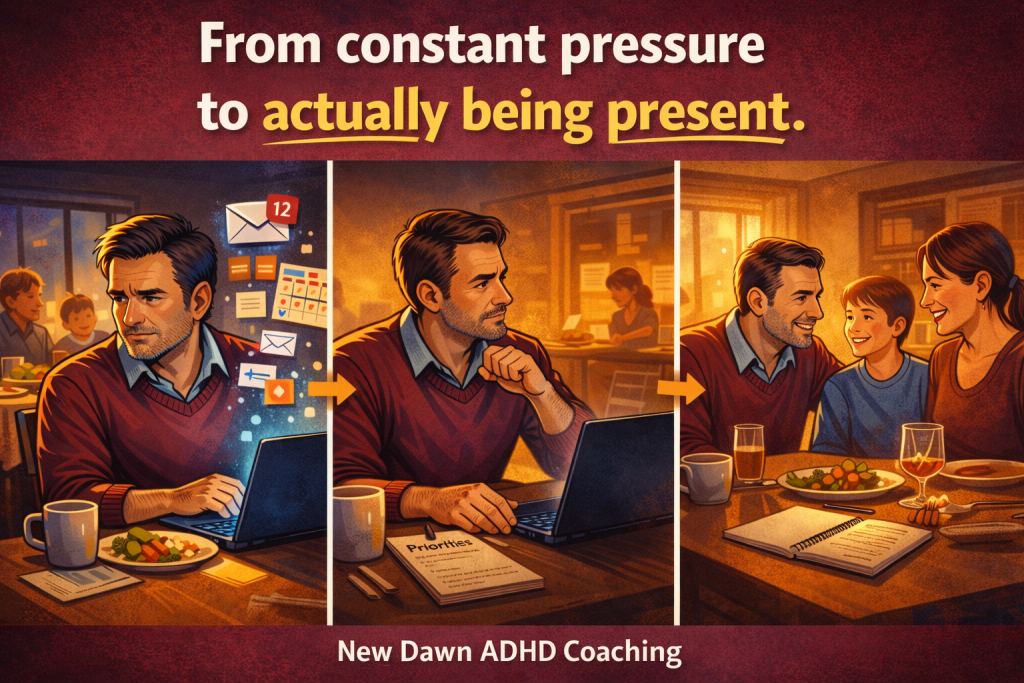
Dinner is on the table. Your family is talking about their day.
Yet part of your mind is still running the business.
You are replaying a conversation from earlier. Thinking about a decision that needs making tomorrow. Wondering if you forgot to send an important email.
Your body is at the table, but your attention is somewhere else.
For many founders and senior professionals with ADHD, this moment is painfully familiar. Work may technically be finished, yet the brain has not switched off. It keeps scanning for problems and analysing decisions, trying to stay one step ahead of whatever might go wrong next.
Often the first person to notice this pattern is not the founder.
It is the person sitting across the table.
Partners frequently notice the same signs beginning to appear at home:
- dinner conversations interrupted by work thoughts
- evenings slowly turning back into work time
- a mind that never seems to switch off
- exhaustion quietly building over time
After a while the pattern becomes exhausting for partners too. They can see how much pressure the founder is carrying, yet the business keeps intruding into the space that used to belong to family life. Over time this can quietly begin to strain the relationship.
From the outside the business may be thriving. Yet this is often one of the hidden costs of ADHD leadership burnout at home.
Where ADHD Leadership Burnout Begins
The term imposter syndrome was first identified in 1978 by psychologists Pauline Clance and Suzanne Imes. They observed that many high achieving people privately believed their success was due to luck rather than ability, despite clear evidence of competence.
For many adults with ADHD this experience can feel familiar.
Perhaps school never quite reflected your ability. Maybe teachers described you as capable but inconsistent. Experiences like these can quietly shape how success is interpreted later in life.
So when someone with ADHD finds themselves leading a team, running a business, or carrying significant responsibility, an uncomfortable thought can appear.
What if someone realises I am not actually as capable as they think?
That pressure rarely stays small.
Why the ADHD Brain Keeps Working After Work
When ADHD leadership burnout begins to build, the mind often starts searching constantly for evidence that everything is under control.
Systems must be organised.
Details must be checked.
Problems must be anticipated.
From the outside this can look like dedication.
Inside it often feels like constant pressure.
The brain stays alert, monitoring what might go wrong. Instead of switching off at the end of the day, it continues analysing situations and solving problems.
This is why many ADHD leaders struggle with work-life balance. Work may technically be finished, yet the mind is still running the business.
When Responsibility Lives in Your Head
Over time leadership can start to feel heavier. Many founders discover that success itself can start to carry an unexpected emotional weight. You can explore this idea further in when ADHD business success feels heavy.
Instead of focusing on the direction of the business, attention shifts toward preventing mistakes.
Questions begin to dominate thinking.
Did I forget something important.
Is that system organised enough.
What if something goes wrong.
The brain keeps processing problems while driving home, cooking dinner, or sitting with family.
Physically at home.
Mentally still at work.
This ongoing pressure is one of the ways ADHD leadership burnout quietly develops.
Signs ADHD Leadership Burnout May Be Building
Common signs include:
- spending more time covering weaknesses than using strengths
- difficulty delegating important work
- double checking tasks others could manage
- feeling responsible for everything going right
- dismissing achievements while focusing on mistakes
- working longer hours but still feeling behind
Gradually something else begins to happen.
Work stops staying at work.
Why Success Rarely Happens Alone
When people look back at meaningful achievements, a common pattern appears.
Success almost always involved other people.
Mentors, teams, colleagues and partners all play a role in progress.
Yet many people with ADHD grow up believing success must be earned independently. Asking for help can feel like weakness.
That belief often carries into leadership.
The result is a tendency to try to prove capability by doing everything alone.
Unfortunately that also increases pressure and contributes to burnout.
Five Practical Tools for ADHD Leaders
1. Build evidence of your achievements
Write down examples of problems you solved and obstacles you overcame. Seeing the evidence helps counter distorted thinking.
2. Clarify the outcome you want
Before delegating, think about the outcome you want to create. Clear outcomes make delegation easier.
3. Look for the right who
Ask who could do the task better or faster than you. Leadership often begins when the question shifts from how to who.
4. Allow people to use their strengths
When capable people are involved, resist controlling every step. Let them bring their expertise.
5. Question the belief that you must do everything
Many ADHD leaders believe success must come through effort alone. Challenging this belief opens the door to more sustainable leadership.
The Strength Behind ADHD Leadership
ADHD can bring creativity, enthusiasm and the ability to see possibilities others miss.
When attention shifts away from constantly covering weaknesses, those strengths have space to appear.
Leadership becomes less about holding everything together and more about guiding direction and bringing the right people together.
Something important begins to change.
The mind becomes quieter.
Work becomes more contained.
Evenings at home begin to feel like evenings again.
Moving Forward
For many founders this pattern runs quietly for years.
The business grows. Responsibilities increase. People rely on you.
Yet evenings never fully switch off. The brain continues running the business long after the working day ends.
Many leaders assume this is simply the price of responsibility.
Often it reflects the hidden cost of ADHD leadership burnout at home.
Once the pattern becomes visible, things can begin to change.
Often the first person to recognise it is not the founder.
It is their partner.
If someone you care about seems unable to switch off from the business even when they want to, a discovery conversation can help uncover what may be driving the pressure.
Understanding the pattern clearly is often the first step towards changing it.
If this feels familiar, you are very welcome to get in touch.