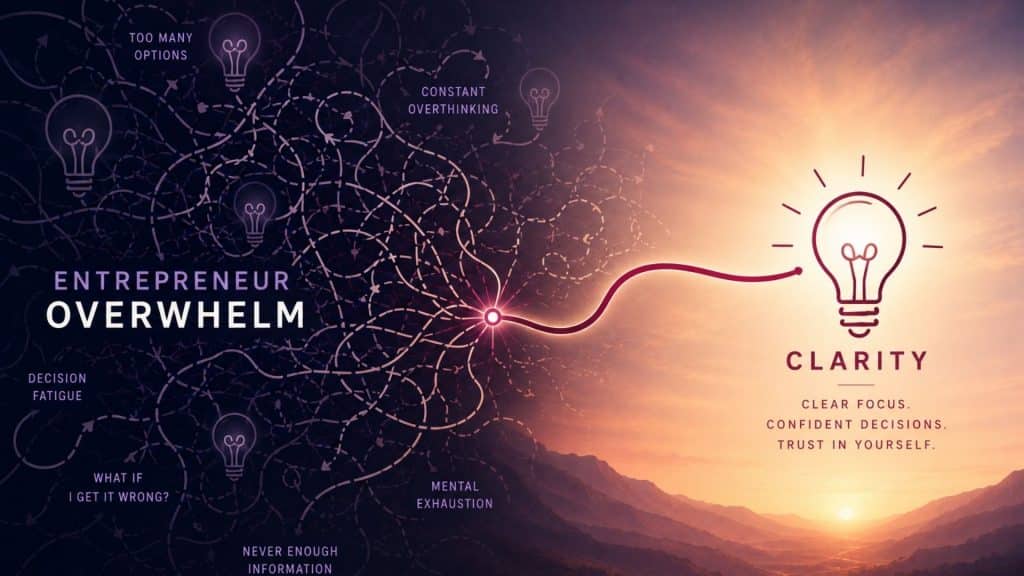
The Secret Behind Entrepreneur Overthinking, and How to Find Greater Clarity
If you’re an entrepreneur, founder or business owner, there’s a good chance your curiosity is one of the reasons you’ve achieved what you have.
You probably think deeply.
You question things other people accept.
You explore possibilities others overlook.
You want to properly understand decisions before committing to them.
That can be a huge advantage in business.
But entrepreneur overthinking can also become exhausting when your brain never fully switches off.
That can be a huge advantage in business.
I recently spoke with Anne-Laure Le Cunff about her work on ADHD and hyper-curiosity, and it really got me thinking about how many entrepreneurs quietly struggle with overthinking, decision fatigue and the inability to switch off.
And honestly, I see this pattern all the time in founders and business owners.
People who are intelligent, driven and capable , but mentally overloaded because their brain never fully stops searching.
Curiosity Can Be a Strength, Until It Becomes Exhausting
A lot of entrepreneurs succeed precisely because they don’t think in a conventional way.
Curiosity helps you:
- spot opportunities others miss
- solve problems creatively
- deeply understand people
- innovate and adapt quickly
But the same strength can also create exhaustion when there are no boundaries around it.
Entrepreneur Overthinking and the Search for Certainty
One of the hidden costs of hyper-curiosity is decision fatigue.
The more possibilities you see, the harder it can become to stop exploring and actually decide.
You may recognise this:
- researching decisions endlessly
- mentally replaying business problems late at night
- opening the laptop “for 10 minutes” and losing another two hours
- constantly thinking about work and struggling to properly switch off even when you’re supposed to be resting
At first, it feels productive, but after a while, overthinking can quietly turn into overwhelm, mental exhaustion and difficulty switching off.
At first, it feels productive, but after a while, overthinking can quietly turn into overwhelm, mental exhaustion and difficulty switching off.
I wrote more about the hidden impact this can have on founders and business owners in the following article:
ADHD Leadership Burnout: The Hidden Cost of Always Carrying the Responsibility
And often there’s another layer underneath it:
difficulty trusting yourself.
One thing I’ve noticed repeatedly , both personally and in my work with entrepreneurs , is that people tend to remember the decisions that went badly far more vividly than the ones that worked out well.
The failed investment.
The wrong hire.
The missed opportunity.
But the countless good decisions you’ve made?
The instincts that were right?
The risks that paid off?
Those often fade into the background.
So instead of trusting yourself, you keep searching for more certainty.
But entrepreneurship will always involve uncertainty.
At some point, every founder has to make decisions without having every answer.
What Helped Me Personally With Decision Fatigue
Years ago, I was working for a major bank.
From the outside, everything looked stable:
- good salary
- secure career
- predictable future
But internally, I knew I wasn’t in the right place.
And over time, that feeling started affecting my energy, motivation and overall wellbeing far beyond work itself.
The difficult part was that leaving meant stepping away from certainty.
I had a wife and family to support.
My income depended entirely on that salary.
And becoming self-employed as a financial adviser meant starting with no guaranteed income at all.
So naturally, I analysed everything endlessly.
Should I stay?
Should I leave?
What if I failed?
What if I regretted it?
Looking back, I can see I was trying to eliminate uncertainty completely before allowing myself to move forward.
What eventually helped wasn’t finding certainty.
It was reframing the decision.
I realised that staying where I was , and continuing to ignore the impact it was having on my mental health and family life , had actually become the bigger risk.
Once I saw that clearly, the decision became much simpler.
I created a business plan, built trusted relationships around me and moved forward.
Within a few months, it worked out financially.
But more importantly, it allowed me to build a career that played to my strengths and helped me develop far more trust in myself.
That was 15 years ago, and I’ve never gone back into employment since.
Redirecting Curiosity Inward
One of the biggest things I’ve learned , both personally and through working with entrepreneurs , is that sometimes the most valuable place to direct curiosity isn’t outward.
It’s inward.
Many founders spend years directing curiosity externally:
- researching
- analysing
- exploring possibilities
- looking for certainty
But often the real breakthrough comes from becoming more curious about yourself.
Questions like:
- What strengths have helped me get this far already?
- Which past decisions actually worked out better than I expected?
- Does this align with the business and life I want to build?
- What is my intuition already pointing me towards?
Because often the issue isn’t lack of information.
It’s lack of trust in yourself.
And sometimes what reduces exhaustion and overwhelm isn’t more research.
It’s recognising the resilience, strengths and judgement you already have.
That’s where I think real clarity often comes from.
Not from endlessly searching externally, but from understanding yourself more deeply and learning how to use your strengths in a more balanced way.
And the return on investment from that can be huge:
- less exhaustion
- clearer decision-making
- better focus
- stronger relationships
- and more ability to switch off and actually be present
Because curiosity can absolutely be a superpower in business.
The key is learning how to use it intentionally rather than letting it quietly run your life.
Further Reading
Some of the reflections in this article were inspired by conversations around hyper-curiosity and entrepreneurial thinking with Anne-Laure Le Cunff, including this
Science News article on ADHD and hyper-curiosity
If you could reduce your decision fatigue by even 20%, what extra energy, clarity and opportunities might open up in your business and life?