Mighty Movement Shifts – Why Movement Isn’t Optional for ADHD Minds (and What to Do About It)
I once tried giving up exercise during a busy patch at work. “I’ll just catch up at the weekend,” I told myself. Big mistake. By Thursday I was pacing the kitchen, forgetting what I’d gone in for, picking fights with the kettle, and feeling like my brain was full of bees. Turns out, movement isn’t a luxury for my ADHD brain, it’s fuel.
And I see this all the time in coaching. Let me introduce you to Sam. He’s fictional, but his story is based on hundreds of real conversations. Sam is a busy sales manager juggling a demanding workload, back-to-back meetings, and a tendency to get stuck in his head when the pressure’s on.
Recently, Sam had a big client presentation coming up. He skipped his usual morning workout, thinking he’d save time. But by the time he arrived, he felt tense, scrambled, and more anxious than usual. Afterwards, he reflected: “I didn’t just feel nervous, I felt trapped in my own head.”
That evening, he went for a run. Just twenty minutes. And everything changed.
Movement and the ADHD Brain
People with ADHD often struggle with self-regulation across attention, mood, energy, and emotion. That’s because the prefrontal cortex (especially the dorsolateral prefrontal cortex, the bit in charge of planning, logic, and focus) relies on neurotransmitters like dopamine to work properly.
And guess what boosts dopamine? Physical activity.
Even a few minutes of movement can:
- Improve working memory and attention
- Reduce anxiety and restlessness
- Increase motivation and mental clarity
- Reset your nervous system after stress
That’s not a motivational poster. That’s neuroscience.
Why We Resist What Helps
So if movement is so helpful, why don’t we do it more?
For ADHD adults, the answer is often twofold:
- The Wall of Activation: Knowing something is good for us doesn’t mean we can start it. The hardest part is getting off the sofa or away from the screen. The brain needs a spark, a sense of urgency, some novelty, or genuine interest to activate.
- All-or-Nothing Thinking: We think if we can’t do 45 minutes at the gym, there’s no point. So we do nothing. But the truth is, five minutes of stretching or star jumps can be enough to regulate our state.
- Gym Dread is Real: For many ADHDers, the idea of going to the gym can feel utterly daunting. Even when we know we’ll feel better afterwards, the prospect of packing a bag, getting there, and dealing with crowds or noise can feel like trying to scale Everest in flip-flops. The very thing that transforms us can also feel almost impossible to begin.
- Winter Blues: Most ADHDers find it harder to exercise in the winter months. As the days grow gloomier, wetter, and colder, and the nights draw in, our motivation often drops too. The couch gets cosier and the walk to the gym feels ten times longer. But these are exactly the times when our brains most need a lift.
Sam learned this the hard way. Now, instead of waiting for a “perfect time” to exercise, he keeps it simple. Press-ups before a Zoom call. A brisk walk round the block before diving into emails. A dance to one song in the kitchen.
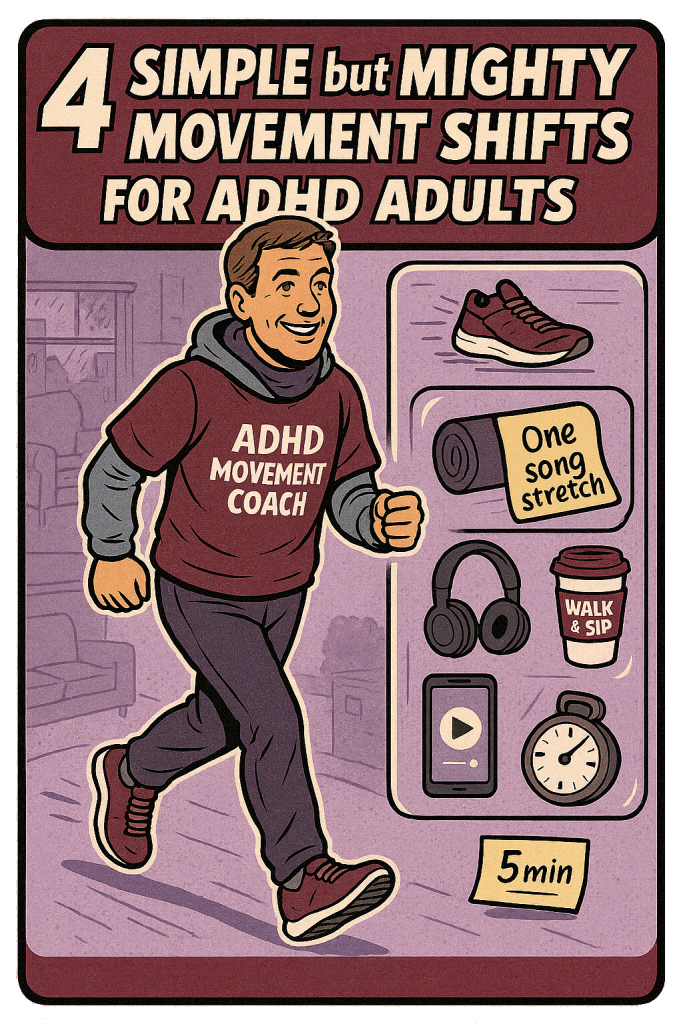
4 Ways to Make Movement ADHD-Friendly
- Pair It With Something You Enjoy
Podcasts, upbeat playlists, or even your morning coffee can become movement cues. Make it pleasurable. - Keep It Tiny and Repeatable
Ten squats while the kettle boils. A one-song stretch in your pyjamas. Don’t wait for the mood, build the routine. - Use Visual Triggers
Keep your trainers by the door. Leave a yoga mat out. ADHD brains love cues and hate decisions. - Track the Feeling, Not the Stats
Forget calories and steps. Ask: “How do I feel afterwards?” Noticing the mental shift builds positive reinforcement.
Coaching Can Help You Move the Way You Want To
In coaching, we start with a simple but powerful question: who do you want to be? What does the version of you who feels calm, focused, and in charge of their energy look like?
From there, we work out what will help you get there, and what’s getting in the way. That might be beliefs about what counts as “real” exercise, fears about looking silly, or simply forgetting to move at all.
Then we get practical. We look at what you’re telling yourself and ask: is this story helping or hindering me? We replace the unhelpful script with something truer and more empowering, something grounded in your real experiences.
And finally, we create a plan so small, so doable, and so personalised that you can’t help but win. We build momentum one step at a time, in a way that actually fits your life.
Because the goal isn’t to become a gym addict. It’s to be someone who knows how to shift their state when they need to, and trusts that they can.
If you’ve been stuck in your head, feeling foggy, restless or low, maybe your body is just asking to move.
And if you’d like support to figure out what works for your unique brain, that’s what coaching is for.
Click here to book a discovery call and let’s get you moving, mind and body
See here for ADHD Imposter Syndrome: 7 Ways to Turn Self-Doubt into Strength.