
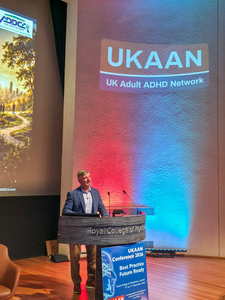
I had butterflies as I watched David Giwerc take the stage at the UKAAN conference. David is the co-founder and president of the ADD Coach Academy (ADDCA), a leading global provider of accredited ADHD coach training. David and I share a passion for ADHD coaching and for raising professional standards. As he talked us through examples of what people can do with the support of a certified ADHD coach, I could feel the excitement in my chest. I’d spent years having conversations about where coaching could fit. After David’s session, I heard people talking about how clinicians and ADHD coaches could work together in a way I hadn’t heard before. It felt like David had sparked something.
Sitting there listening to David, I thought back to the moment I introduced him to Kobus. I felt proud of the part I’d played in getting us to this point. It felt like the culmination of years of work. And I had the sense we were only just getting started.
What I wanted people in the room to take away was something practical. If you’ve spent years struggling with things that seem easier for other people, how do you know what good support looks like? You might have just been diagnosed, have known you have ADHD for years, or still be trying to make sense of what’s going on. That question is why I care about ADHD coaching standards.
Why did I get involved in shaping UK ADHD coaching standards?
When I left my career as a Chartered Financial Planner to become an ADHD coach, I wanted to help people understand how ADHD affects their lives and find ways of working that fit. At an earlier conference run by the UK Adult ADHD Network, or UKAAN, I wanted to hear how clinicians saw coaching. UKAAN trains healthcare professionals in adult ADHD assessment, treatment and support. Explore UKAAN’s training
Some of the clinicians I spoke with saw real value in coaching. What gave them pause was the referral itself. They wanted to know what training to look for and what they could expect a coach to do. I kept thinking about what it must be like for someone trying to answer those same questions on their own, when they’ve already spent years trying to work things out for themselves.
I trained at ADDCA and went on to introduce Kobus van Rensburg to David. I’ve since worked with David, Kobus and others as an independent ADHD coach, contributing to a consensus paper that’s still in development. Watching David explain his work to a room full of people who support adults with ADHD brought those first conversations back to me. See the UKAAN conference programme
What should adults expect from a professional ADHD coach?
Some people come to me after working with a coach who didn’t specialise in ADHD. Others had worked with someone who called themselves an ADHD coach but lacked the specialist training to adapt their approach. Imagine leaving a session with a fresh planner and a list of things to do, then opening the planner a week later to find Monday filled in and the rest of the pages blank. If you’ve spent years telling yourself you should be able to keep up, that blank page can feel like one more reason to blame yourself. That’s why I care about how a coach puts their ADHD training into practice.
The aim of the consensus paper is to give clinicians, coaches and adults seeking support a clearer account of what ADHD coaching involves, what training and professional practice to look for, and when a referral might be appropriate. For me, it comes down to giving people better questions to ask and helping them make sense of the answers.
What should you ask before choosing an ADHD coach?
What ADHD-specific training have you completed?
Ask what the training involved and how it informs the way they work. If they list a credential, ask who awarded it and where you can verify it.
Who do you usually work with?
Ask whether they’ve worked with people facing similar challenges. Notice how much time they spend listening to what you want to change.
What happens if I turn up overwhelmed?
Ask what a session might look like in a difficult week. Their answer can give you a feel for how they adapt when your plans have already gone out of the window.
How will we know whether coaching is helping?
Pick a change that would matter to you. It might be closing the laptop in time for dinner a couple of evenings a week.
How do you handle confidentiality and referrals?
Ask how they protect what you share. Find out how they’d handle something that calls for input from a clinician or another professional.
How can ADHD coaching help with everyday overwhelm?
A diagnosis can help you make sense of things you’ve struggled with for years. Then it’s Monday morning. You had a plan for the week and were looking forward to getting started. Now your coffee’s gone cold and there are forty new emails on top of everything already sitting in your inbox. You don’t know where to start.
Here we go again. You tell yourself you’ll catch up, then go round in circles trying to decide what to do first. By the time you pick something, the enthusiasm you started with has gone. You feel exhausted before you’ve really begun.
That’s a cycle ADHD coaching can help you break. We can look at what happens between opening your inbox and feeling defeated, then try a different first step. Perhaps you talk it through and pick the one email that would make the biggest difference to your morning. You can start there, even with the rest of the inbox still waiting.

What does the research say about ADHD coaching for adults?
Elizabeth Ahmann, Micah Saviet and Mark Otto describe their project as the first outcomes study of one-to-one ADHD coaching for adults. Every coach was experienced, had completed at least 35 hours of ADHD-specific coach training and held a credential from the International Coaching Federation (ICF), the Professional Association for ADHD Coaches (PAAC), or both. The findings describe what happened with coaches who met those requirements. Read the initial study
After 12 sessions, 43 adults who completed the programme and final assessment reported improvements in executive functioning, ADHD symptoms and daily functioning. A second paper from the same project found those gains were still evident among 42 people at six weeks. Twenty-four received some further coaching during that period. The study had no comparison group, and the follow-up was short. Read the six-week follow-up
What would you like to be different?
When I think back to David speaking, I think about the person still at their laptop long after dinner, trying to get one last thing done so tomorrow feels a little less daunting. I’d like that person to know what good coaching could offer and feel able to ask a coach how they’d help.
If you’re considering coaching, start with the question I ask in my own practice. What would you most like to be different in your life as a result of coaching? If you’d like to talk that through, you’re welcome to book a discovery call with me at New Dawn ADHD Coaching.